





For decades, the dream has been remarkably consistent: a robot that walks around your home, picks up clothes, loads the dishwasher, cleans the kitchen, carries groceries, and handles all those little chores nobody wants to do.
- The Problem Isn’t Making a Robot Walk
- AI Is Finally Giving Robots More Common Sense
- Real Household Robots Are Starting to Appear
- LG Is Taking a Different Approach
- Why Laundry Is Surprisingly Difficult
- Safety May Be Harder Than Intelligence
- The First Great Home Robot May Not Look Human
- So When Will We Actually Have Robot Helpers?
In 2026, we’re closer to that future than we’ve ever been.
But there’s an important distinction: useful home robots already exist; truly general-purpose home robots largely don’t.
Robot vacuums and other specialized machines can reliably perform narrow jobs today. The exciting development is that a new generation of AI-powered robots is beginning to tackle much broader household tasks.
The Problem Isn’t Making a Robot Walk
Watching a humanoid robot walk across a room is impressive, but walking isn’t what will make it valuable in your kitchen.
The difficult part is dealing with the chaos of an ordinary home.
Consider something as simple as:
“Clean the kitchen.”
A human immediately understands that this could involve collecting cups, identifying dirty dishes, throwing away rubbish, loading a dishwasher, wiping surfaces, moving objects without breaking them, and recognizing things that shouldn’t be touched.
Nothing is perfectly positioned.



A glass might be half full. A knife might be hidden beneath a plate. Someone may leave a chair in the robot’s path halfway through the task.
Useful home robots need to deal with that unpredictability.
AI Is Finally Giving Robots More Common Sense
This is where recent advances become particularly interesting.
Traditional robots excel when their environment is highly controlled. A factory robot can repeat the same precisely programmed movement thousands of times.
Homes are the opposite.
Newer robotics models are being designed to understand language, visual information, physical space, and actions together.
Google DeepMind’s Gemini Robotics research, for example, is focused on allowing robots to understand everyday instructions, reason about physical environments, manipulate objects, and adapt when circumstances change.
Its Gemini Robotics 2 model, introduced in July 2026, demonstrates increasingly sophisticated whole-body control and dexterity—including manipulating objects with multi-fingered robotic hands.


That doesn’t mean a Google robot is about to arrive at your front door.
It means the AI brain required for more capable robots is advancing quickly.
Real Household Robots Are Starting to Appear
One of the most interesting examples is 1X’s NEO, a humanoid robot designed specifically around household assistance.
The company presents NEO as capable of handling chores and allows customers in the United States to place reservations, with deliveries planned to begin before the end of 2026.
But there’s a major caveat.
For tasks the robot cannot complete autonomously, 1X provides an Expert Mode through which a human expert can remotely assist it.
That’s actually a useful illustration of where home robotics currently stands.
The robot may look futuristic, but complete household autonomy remains difficult.
We’re entering an awkward transitional period where robots can perform increasingly impressive tasks but may still require human assistance when they encounter unfamiliar situations.
LG Is Taking a Different Approach
Humanoid robots aren’t the only strategy.
At CES 2026, LG demonstrated CLOiD, an AI-powered home robot designed to work with the company’s connected-home ecosystem.
LG showed the robot performing scenarios involving food preparation and laundry, including retrieving milk from a refrigerator and handling clothing after a laundry cycle.
This points toward another possible future.
Instead of building a robot capable of operating every appliance exactly like a human, manufacturers could design robots and smart appliances that cooperate with each other.
Your future robot may not need to physically press every washing-machine button if it can simply communicate with the washing machine.
Why Laundry Is Surprisingly Difficult
Folding a T-shirt looks trivial until you try to teach a machine to do it.
Fabric changes shape constantly.
A robot needs to determine where the garment begins and ends, identify sleeves and corners, understand how it’s positioned, grasp flexible material correctly, and manipulate it without losing control.
Dishwashers create similar problems.
Plates, glasses, cutlery, bowls, pans, leftovers, fragile objects, and sharp utensils can appear in countless arrangements.
Humans solve these problems almost unconsciously.
For robots, they’re difficult perception and manipulation challenges.
That’s why demonstrations involving laundry, dishes, and other ordinary household objects are actually significant milestones.
Safety May Be Harder Than Intelligence
A home robot doesn’t operate behind a factory safety barrier.
It operates around children, pets, furniture, glassware, stairs, hot surfaces, and people who may behave unpredictably.
A useful robot therefore needs to understand not only how to accomplish a task, but when it should stop.
What happens when a toddler suddenly runs in front of it?
What if the robot misunderstands an instruction?
What if someone leaves a dangerous object somewhere unexpected?
The robotics industry is increasingly treating safety as a system-level problem. NVIDIA, for example, introduced a dedicated full-stack robotics safety architecture in 2026 as physical AI systems move toward more dynamic environments alongside humans.
Household robots will ultimately be judged less by impressive demonstrations and more by whether families can safely trust them every day.
The First Great Home Robot May Not Look Human
There’s also an assumption worth questioning:
Why does a household robot need legs and a face?
Robot vacuums became successful precisely because they didn’t attempt to imitate humans. They’re compact machines optimized for one task.
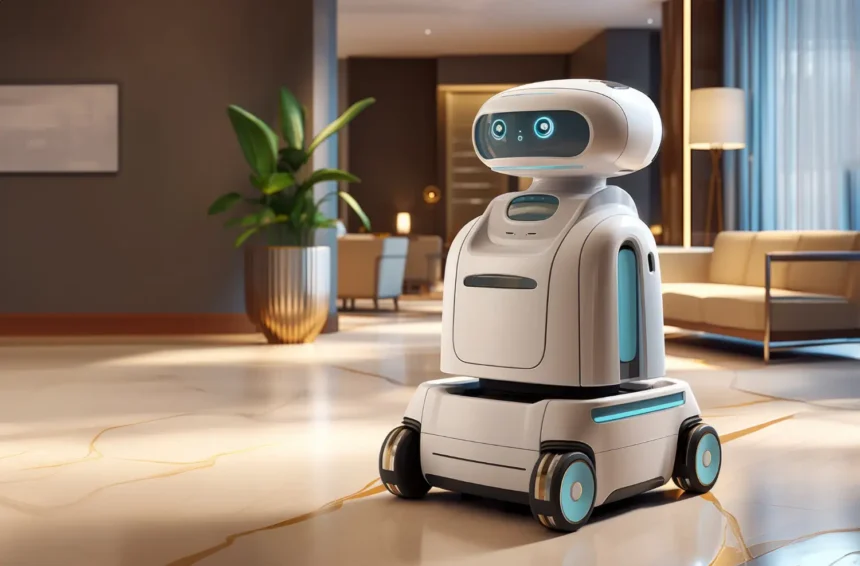
Future household robots could similarly use wheels, adjustable arms, specialized grippers, or entirely new designs.
Humanoid robots do have an important advantage: our homes were designed for human bodies. Doors, stairs, cabinets, countertops, appliances, and tools all assume roughly human proportions.
But if wheels make a robot cheaper, safer, more stable, and more energy-efficient, being less human could actually make it more useful.
So When Will We Actually Have Robot Helpers?
If by “home robot” you mean a machine that performs one specialized job reliably, we’re already there.
If you mean a more capable machine that can perform several household tasks under the right conditions, the first serious products are beginning to emerge.
If you mean an affordable robot that can independently walk into almost any home, understand dozens of chores, manipulate unfamiliar objects safely, deal with children and pets, operate all day, and recover intelligently when something unexpected happens?
We’re not there yet.
And anyone giving you an exact year is guessing.
The progress in AI reasoning, robotic dexterity, simulation, sensors, and physical AI during 2026 is significant. But impressive laboratory demonstrations still need to become reliable consumer products capable of repeating those tasks thousands of times in messy real homes.
The robot butler is no longer purely science fiction.
It’s becoming an engineering problem—and engineers are making surprisingly fast progress.