






Household chores aren’t just a convenient way for parents to get some help around the house. When responsibilities are introduced gradually and appropriately, they can teach children that maintaining a home requires cooperation, consistency, and practical effort. They also give children opportunities to develop skills they will eventually need when they become independent adults.
- Ages 2–3: Start With Participation, Not Responsibility
- Ages 4–5: Give Them Small Jobs With Clear End Points
- Ages 6–8: Introduce Regular Household Responsibilities
- Ages 9–11: Build Useful Life Skills
- Ages 12–14: Move Toward Genuine Independence
- Ages 15–18: Prepare Teenagers for Life Without You
- Teach Every Child the Same Core Skills
- Why Chores Matter Beyond Having a Cleaner House
- Teach the Chore Before Expecting Independence
- Don’t Immediately Redo Everything They Do
- Use Checklists Instead of Repeating Yourself Twenty Times
- Should Children Be Paid for Chores?
- Don’t Turn Every Chore Into a Punishment
- Don’t Overload the Child Who Never Complains
- Chores Should Never Replace Childhood
- What If Your Child Refuses to Do Chores?
- The Final Step Is Learning to Notice What Needs Doing
- The Real Goal Isn’t a Child With a Perfectly Clean Bedroom
The objective isn’t to turn children into miniature housekeepers or create a home where every unfinished chore leads to an argument. Children still need plenty of time for school, sleep, friendships, hobbies, physical activity, and unstructured play. Chores should occupy a reasonable place within childhood rather than becoming the center of it.
The difficult question for many parents is deciding what children can realistically do at different ages. There is no perfect universal schedule, because development, experience, coordination, maturity, disabilities, family circumstances, and the layout of the home can all affect what a particular child can manage. Age-based recommendations are therefore most useful as starting points rather than strict rules.
Ages 2–3: Start With Participation, Not Responsibility
Toddlers don’t need a formal weekly chore schedule, but they can begin participating in very simple household activities. At this age, the goal is primarily to introduce the idea that things are put away after they’re used and that everyone can contribute in small ways. Tasks should be short, safe, concrete, and performed with an adult nearby.



| Possible Chore | Appropriate Expectation |
|---|---|
| Put toys into a box | With reminders |
| Put books on a low shelf | With help |
| Place dirty clothes in a basket | Mostly independently |
| Put shoes in their usual place | With reminders |
| Carry safe items to the table | Closely supervised |
| Wipe a small spill | With help |
| Help feed a pet | Closely supervised |
| Throw appropriate rubbish away | With guidance |
A two-year-old wiping a table probably won’t clean it particularly well, and that’s perfectly reasonable for their developmental stage. The important lesson is the sequence: something became messy, so now we help clean it. If adults expect professional results from toddler chores, an activity that could build confidence can quickly become frustrating for everyone.
Ages 4–5: Give Them Small Jobs With Clear End Points
Preschool-age children can often take more responsibility for their belongings and participate more actively in household routines. They still need reminders and supervision, but many can complete simple tasks once they’ve been shown exactly what to do. Jobs with obvious beginning and end points usually work better than broad instructions.
For example, telling a four-year-old to “clean your room” requires them to interpret several different tasks simultaneously. Saying “put the blocks in this box and the books on that shelf” makes the expectation much easier to understand. As children gain experience, several smaller instructions can gradually be combined into a larger responsibility.
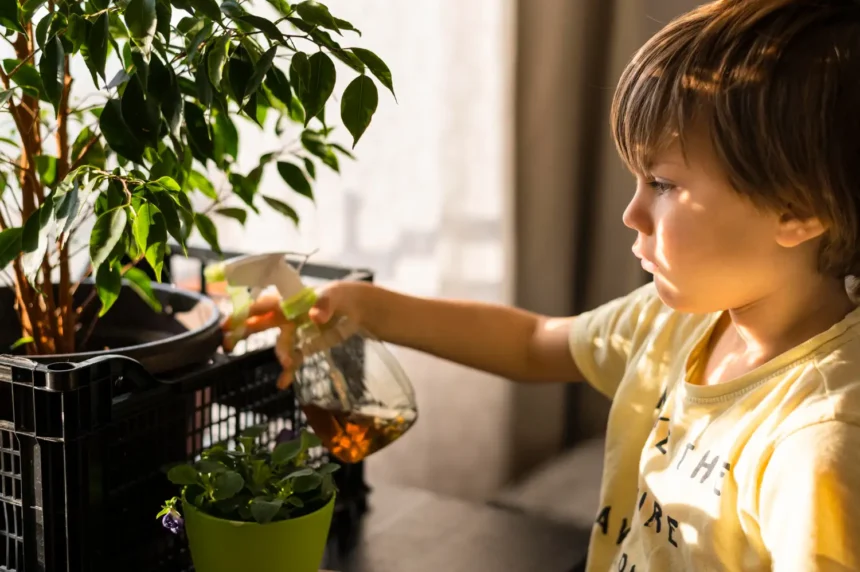
Children around this age may be able to put away toys, help set the table, match socks, place clothing in a laundry basket, water plants, carry light groceries, wipe accessible surfaces, and approximately make their bed. They can also begin returning backpacks, coats, and shoes to designated locations. The result doesn’t need to look exactly the way an adult would have done it for the activity to be worthwhile.
Ages 6–8: Introduce Regular Household Responsibilities
Early primary-school years are a useful time to move from occasional helping toward a few predictable responsibilities. Children can begin learning that certain tasks belong to them and don’t need to be presented as a special favor every time. This introduces the concept of ownership without expecting adult-level independence.
| Personal Responsibilities | Household Responsibilities |
|---|---|
| Make the bed | Set or clear the table |
| Put dirty clothes away | Sweep small areas |
| Organize school belongings | Help unload the dishwasher |
| Put clean clothes in drawers | Water plants |
| Keep bedroom reasonably tidy | Sort laundry |
| Put shoes and coat away | Help prepare simple foods |
| Prepare items for school | Participate in pet care |
The appropriate amount of supervision depends heavily on the task. Anything involving heat, knives, strong cleaning products, heavy objects, electrical equipment, or potentially unpredictable animals requires additional judgment from an adult. The objective isn’t to discover the maximum amount of work a seven-year-old can technically perform, but to establish manageable responsibilities that can become routine.



This is also a good age to begin explaining why chores matter instead of simply issuing instructions. A child can learn why food scraps are removed from dishes, why wet towels shouldn’t remain on the floor, and why clean clothes need somewhere appropriate to go. Understanding the reason behind a task can make household routines feel less arbitrary.
Ages 9–11: Build Useful Life Skills
By approximately nine to eleven years old, many children can handle tasks involving several steps, particularly if they’ve been participating in household work for years. This is an excellent period for teaching skills that will eventually become necessary for independent living. Parents can demonstrate new responsibilities, complete them together initially, and gradually reduce supervision as competence improves.
Possible chores can include vacuuming, folding laundry, changing bedding, loading and unloading the dishwasher, taking rubbish out, preparing simple meals, cleaning appropriate bathroom surfaces, helping wash a car, and assisting with grocery shopping. Children can also take more responsibility for keeping track of school belongings and maintaining their personal spaces. The exact tasks should reflect what the individual child can safely and consistently manage.
This is also an opportunity to explain the hidden knowledge behind ordinary household work. Children can learn why certain clothes require different washing instructions, why some foods must be refrigerated, why raw meat requires careful handling, and why cleaning chemicals should never be mixed casually. Chores become much more valuable when children learn the reasoning behind them rather than merely following instructions.
Ages 12–14: Move Toward Genuine Independence
Early adolescence is a good time to expand responsibility beyond maintaining a bedroom or occasionally helping after dinner. Young teenagers can increasingly learn to complete entire household tasks from beginning to end, although their previous experience still matters enormously. A thirteen-year-old who has never operated a washing machine needs instruction regardless of what an age-based chore chart says.
Depending on maturity and experience, teenagers at this stage may begin managing their own laundry, changing bedding, vacuuming, mopping appropriate areas, preparing simple meals, cleaning up after cooking, taking out recycling, caring for pets, and helping with shopping. They can also become responsible for noticing when personal supplies need replacing. These activities begin shifting household work from “something my parents make me do” toward skills needed for ordinary adult life.
Parents can also start introducing the organizational side of running a home. Teenagers can help prepare shopping lists, check what ingredients are already available, compare supermarket prices, understand food expiration and storage, and participate in planning meals. Maintaining a household requires much more than knowing how to use a vacuum cleaner, and adolescence provides plenty of opportunities to learn that gradually.
Ages 15–18: Prepare Teenagers for Life Without You
Later adolescence changes the purpose of chores considerably. Instead of asking only what teenagers can do around the family home, parents can start considering what they would need to know if they moved out in the near future. Any major gaps can then be addressed while guidance and support are still readily available.



| Life Skill | What Teenagers Can Gradually Learn |
|---|---|
| Laundry | Wash, dry, fold and care for clothing |
| Cooking | Prepare several complete meals |
| Cleaning | Maintain a kitchen, bathroom and living area |
| Shopping | Make lists, compare prices and follow a budget |
| Food safety | Store and prepare food appropriately |
| Organization | Manage belongings, responsibilities and schedules |
| Household supplies | Notice when essentials need replacing |
| Basic maintenance | Handle simple safe household tasks |
| Money | Understand basic budgeting and recurring costs |
| Shared living | Contribute fairly when living with others |
An older teenager ideally shouldn’t arrive at university, work, or their first apartment without knowing how to wash clothes or prepare basic food. They don’t need to become excellent cooks or know how to repair everything that breaks, but they should understand the fundamentals of looking after themselves and their living space. Practical independence is easier to develop through years of gradual responsibility than through a crash course immediately before leaving home.
This preparation also benefits teenagers who continue living with their parents into adulthood. Independent living skills aren’t valuable only when someone moves into their own apartment. They help young adults become more capable contributors wherever and with whomever they live.
Teach Every Child the Same Core Skills
Household responsibilities shouldn’t automatically be divided according to gender. Girls shouldn’t be expected to inherit cooking, laundry, and cleaning while boys are taught only outdoor jobs, tools, or basic maintenance. Every child benefits from learning a broad range of practical skills because nobody knows what their future household will look like.
Boys need to know how to clean bathrooms, cook meals, wash clothes, and care for their living environment. Girls similarly benefit from learning how household equipment works, how to perform basic maintenance, and how to handle practical problems safely. The goal is to raise capable adults rather than assigning children to traditional categories of household work.
Rotating responsibilities can help accomplish this while also reducing arguments about unpopular tasks. One child might clear the table while another helps with the dishwasher, and they can switch later. Other responsibilities can remain permanent when consistency is useful, creating a balance between routine and broader skill development.
Why Chores Matter Beyond Having a Cleaner House
The most obvious benefit of chores is practical: household work is distributed among more people. Their developmental value, however, comes from the repeated practice involved in remembering responsibilities, completing tasks, solving small problems, and contributing to something larger than oneself. Research has explored associations between childhood household tasks and areas such as self-efficacy, executive functioning, prosocial behavior, and perceptions of competence, although chores alone obviously don’t determine how successful a child becomes.
The useful mechanism is much simpler than claiming that washing dishes creates successful adults. Children repeatedly experience having a responsibility that doesn’t disappear simply because they don’t particularly feel like doing it. They also experience the satisfaction of becoming capable at tasks that initially required considerable help.
Chores can additionally create a sense of contribution within the family. When a child sets the table, prepares part of dinner, feeds an animal, or puts clean towels away, their effort genuinely benefits other people. Over time, the underlying household message can become straightforward: we all live here, so we all contribute in ways appropriate to our abilities.
Teach the Chore Before Expecting Independence
Adults often underestimate how much knowledge is hidden inside a simple instruction such as “clean the bathroom.” A child needs to know which surfaces should be cleaned, which products are appropriate, what order makes sense, how much product to use, what hygiene precautions matter, and what “finished” actually looks like. Without that knowledge, frustration can arise because the parent and child are working from completely different definitions of the task.
A better approach is to demonstrate the chore first and explain the important steps. Perform it together the next few times, then allow the child to take the lead while the adult remains available for guidance. Once they can perform it safely and reliably, gradually reduce supervision.
This progression is particularly important for potentially hazardous tasks. Children should never be expected to learn independently through trial and error when knives, cooking heat, electrical equipment, strong chemicals, heavy objects, or other meaningful risks are involved. Independence should increase alongside demonstrated competence rather than simply appearing at a predetermined birthday.
Don’t Immediately Redo Everything They Do
One of the easiest ways to make children feel that chores are pointless is to correct every result the moment they finish. If a child makes the bed and an adult immediately remakes it, or folds towels only to watch someone refold every one, the message is difficult to miss. Their contribution starts feeling symbolic rather than genuinely useful.
Parents need to distinguish between tasks where precision matters and tasks where “good enough” is perfectly acceptable. Food-safety mistakes, dangerous chemical use, and improperly secured equipment obviously require correction, while a slightly crooked duvet does not. Allowing imperfect but acceptable work gives children room to become more capable through practice.
That doesn’t mean standards should disappear completely. Expectations can increase gradually as children’s skills improve, just as they would when learning any other practical ability. The nine-year-old who folds towels awkwardly today may become the fifteen-year-old who handles their entire laundry routine without assistance.
Use Checklists Instead of Repeating Yourself Twenty Times
Some children struggle with household responsibilities because instructions such as “tidy your bedroom” contain too many invisible steps. A simple checklist can transform a vague expectation into a sequence they can follow independently. For younger children, pictures can be used instead of written instructions.
A bedroom checklist might include dirty clothes in the basket, rubbish in the bin, books on the shelf, toys put away, bed reasonably made, and desk cleared. Instead of repeatedly telling the child what comes next, the adult can direct them toward the checklist. Over time, many children internalize the sequence and stop needing it.
This approach can also reduce conflict because the definition of “finished” is established before the task begins. The child knows what is expected, and the parent doesn’t need to keep adding surprise requirements afterward. Predictable expectations are generally easier to manage than constantly changing ones.
Should Children Be Paid for Chores?
Families take very different approaches to allowances, and there isn’t one system that works for everyone. Some parents believe ordinary household chores should be completed without payment because contributing is part of family life, while others connect chores with allowances to introduce earning, saving, and spending. Both approaches can be used thoughtfully.
One practical compromise is distinguishing between routine responsibilities and additional paid jobs. A child might be expected to clear their dishes, maintain their room, and complete one household task because they are part of the family, while earning money for occasional larger jobs such as washing the car or helping organize a storage area. This allows parents to teach both household contribution and the concept of earning money through additional work.
Whatever system a family chooses, consistency matters. Children should understand which tasks are normal responsibilities, which can earn money, and what happens when responsibilities aren’t completed. Constantly changing the arrangement depending on parental frustration makes the system harder for everyone to understand.
Don’t Turn Every Chore Into a Punishment
Household work becomes much harder to normalize if children encounter it primarily as a consequence for misbehavior. If every argument ends with “Now you have to clean the kitchen,” cleaning naturally begins to represent punishment. That works against the broader idea that contributing to a household is simply part of living with other people.
This doesn’t mean children can’t receive additional responsibilities or logical consequences in appropriate circumstances. The important distinction is avoiding a pattern where ordinary household contribution is portrayed as something inherently unpleasant reserved for people who have behaved badly. Routine chores work better when they’re predictable and emotionally neutral.
Parents can still acknowledge that chores aren’t always enjoyable. Adults don’t necessarily look forward to cleaning a toilet or taking rubbish outside either, yet those jobs still need doing. Learning to complete necessary tasks without expecting every activity to be entertaining is itself a useful part of growing up.
Don’t Overload the Child Who Never Complains
Many families have one child who reliably completes whatever they’re asked to do. This can accidentally result in that child receiving more responsibilities simply because asking them is easier than dealing with a sibling who protests. Over time, the responsible child effectively becomes punished for being cooperative while resistance becomes a successful way to avoid work.
Household responsibilities don’t need to be mathematically identical because children’s ages, abilities, school demands, and circumstances differ. They should, however, feel reasonably fair. Parents can occasionally review the distribution of work rather than assigning tasks automatically to whoever is most likely to complete them without argument.
Fairness also means recognizing invisible responsibilities. An older child who already has substantial academic demands or legitimate family responsibilities may not need additional chores simply because they are older. The objective is meaningful participation, not maximizing the amount of unpaid household labor children can perform.
Chores Should Never Replace Childhood
Children need time that has no productive purpose whatsoever. Play, friendships, hobbies, physical activity, rest, sleep, and simply doing nothing are important parts of growing up. A reasonable household routine should coexist with those things rather than consuming them.
Particular caution is appropriate when older children become responsible for substantial caregiving or household management that would ordinarily belong to adults. Helping a younger sibling occasionally, preparing a family meal, or contributing during a difficult week can be normal family participation. Regularly carrying adult-level responsibilities that interfere with education, sleep, relationships, or well-being is a very different situation.
A useful test is whether chores are teaching independence or requiring the child to function as an additional parent. The first can be developmentally valuable, while the second may place an inappropriate burden on them. Responsibilities should grow with children without asking them to grow up before they need to.
What If Your Child Refuses to Do Chores?
Resistance doesn’t always mean laziness or defiance. Before assuming the child simply refuses to contribute, check whether they actually understand the task, whether the instruction is too broad, whether the chore is appropriate for their ability, and whether expectations have been consistent. Sometimes a child who appears unwilling is actually confused or overwhelmed.
There will also be times when the explanation is much simpler: they don’t want to do it. Children aren’t fundamentally different from adults in this respect, because plenty of necessary household jobs aren’t enjoyable. Part of developing responsibility is learning that some tasks still need completing even when motivation is low.
Keep expectations predictable and proportionate rather than turning every unfinished chore into a major family confrontation. Clear routines, reasonable consequences, checklists, and established responsibilities generally work better than repeated shouting. The long-term objective is for children to need progressively less external management.
The Final Step Is Learning to Notice What Needs Doing
A child who takes the rubbish out after being reminded has learned how to perform the chore. A teenager who notices that the bin is full and takes it out without anyone asking has developed something more important. They have begun taking responsibility for the environment around them.
That transition doesn’t happen immediately, because noticing household work is itself a skill. Initially, adults provide reminders and instructions, then schedules or checklists can take over some of that work, and eventually the child begins managing responsibilities independently. The aim is to gradually remove the parent from the role of permanent household project manager.
This matters because adult life rarely provides someone standing nearby announcing every task that needs completing. Laundry accumulates, refrigerators empty, bathrooms become dirty, bills arrive, and rubbish bins fill whether anybody issues instructions or not. Independence means developing the ability to recognize those needs and respond appropriately.
The Real Goal Isn’t a Child With a Perfectly Clean Bedroom
Childhood chores are ultimately preparation for a future that may still be many years away. One day, your child may live in a university residence, share an apartment with friends or a partner, or maintain a home of their own. At that point, nobody should need to explain for the first time how to wash clothes, prepare dinner, clean a bathroom, shop for groceries, or contribute fairly to a shared living space.
Those abilities don’t suddenly appear at eighteen. They develop through hundreds of ordinary experiences in which children first watch, then help, then practice, and eventually take responsibility themselves. A toddler putting toys into a basket is taking the earliest step in the same process that may eventually lead to a teenager preparing dinner and cleaning the kitchen independently.
The most valuable outcome therefore isn’t perfectly folded towels or a spotless childhood bedroom. It is raising someone who understands that homes require work, knows how to perform that work safely, and doesn’t automatically expect another person to handle it for them. Eventually, the question you want them to stop asking is “What do I have to do?” and start asking instead: “What needs to be done?”