






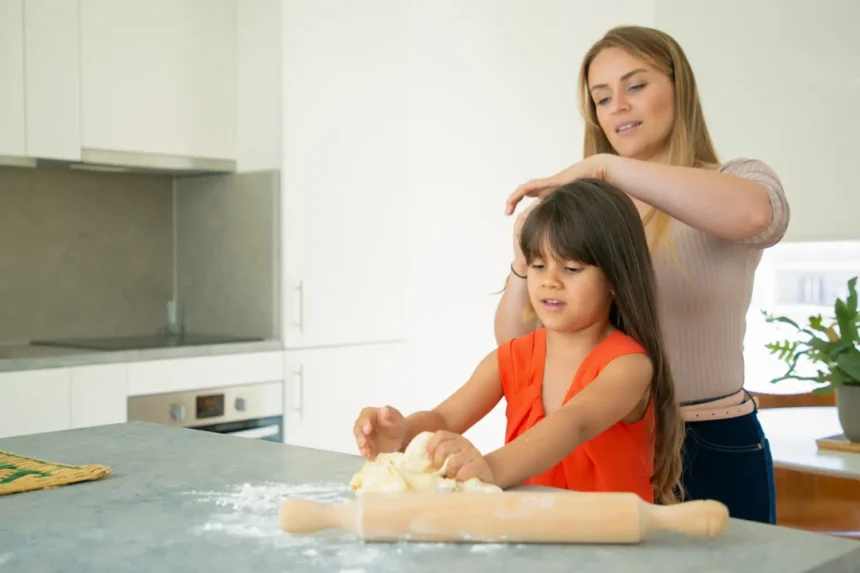
Cooking with children sounds wonderful in theory. You imagine a cheerful family making homemade pizza together while everyone learns useful skills and happily eats vegetables they previously refused to touch.
- Start When You’re Not in a Hurry
- Give Children Real Jobs, Not Pretend Jobs
- What Can Children Do at Different Ages?
- Teach Handwashing Before Recipe Reading
- Don’t Teach Children to Fear Knives—Teach Them to Respect Them
- Teach Heat as a Separate Skill
- Begin With Food They Already Like
- Homemade Pizza Is Almost Perfect for Beginners
- Let Them Choose Between Two Options
- Take Them Shopping for Their Recipe
- Teach Them How to Read a Recipe Before Starting
- Allow Mistakes That Aren’t Dangerous
- Resist the Urge to Take Over
- Taste While You Cook
- Use Cooking to Explore Science
- Let Them Modify Recipes
- Cooking Can Help With Unfamiliar Foods—But Don’t Turn It Into a Trick
- Give Older Children Responsibility for One Meal
- Teach the Boring Parts Too
- Teach Leftovers and Food Waste
- Let Teenagers Cook When You’re Not “Teaching”
- Try a Family Cooking Challenge
- Safety Always Comes Before Independence
- The Goal Isn’t Raising a Child Who Loves Cooking
Then reality arrives.
There’s flour on the floor, an egg has been crushed rather than cracked, someone has mysteriously used four bowls to mix one ingredient, and the recipe that normally takes 25 minutes has entered its second hour.
Cooking with children is slower and messier than cooking alone. That’s not a sign you’re doing it badly. The mess is partly what learning looks like.


The important thing is to stop thinking of children as tiny assistants who must perform every task perfectly. Instead, treat cooking as a practical skill they can gradually learn until they genuinely become useful and increasingly independent in the kitchen.
Start When You’re Not in a Hurry
The worst time to teach a child how to cook is probably 6:20 p.m. on a Tuesday when everyone is hungry and dinner needs to be ready immediately.
Choose a calmer moment for the first few attempts.
Weekend breakfasts, afternoon baking, school holidays, and simple lunches can work particularly well because there is less pressure to finish quickly.
Once children develop basic skills, they can begin helping during normal weekday cooking too. Eventually, their participation may actually save time.
Initially, assume everything will take longer.

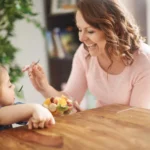

That expectation alone makes the experience considerably more enjoyable.
Give Children Real Jobs, Not Pretend Jobs
Children quickly recognize when they’re being given meaningless tasks just to keep them occupied.
If possible, give them something that genuinely contributes to the meal.
A young child can wash vegetables, tear lettuce, mix ingredients, or arrange toppings. An older child can measure ingredients, peel appropriate foods, prepare a salad, monitor a timer, or follow part of a recipe.
Teenagers can eventually prepare entire components—or the whole meal.
When children can point at dinner and say “I made that,” participation feels meaningful.
What Can Children Do at Different Ages?
There isn’t a universal age at which a child becomes ready for a particular kitchen task. Coordination, maturity, experience, equipment, and supervision all matter.
The following should therefore be treated as a general progression rather than a rigid developmental timetable.


| Approximate Stage | Possible Kitchen Tasks | Supervision |
|---|---|---|
| Preschool | Washing produce, tearing leaves, stirring cool ingredients, adding pre-measured ingredients | Very close |
| Early primary | Measuring, mixing, assembling sandwiches, cracking eggs with help, using simple utensils | Close |
| Older primary | Peeling suitable foods, reading recipes, basic cutting with appropriate instruction, making simple cold dishes | Regular |
| Preteen | Preparing simple meals, using some appliances, basic stovetop skills with instruction | Depends on experience |
| Teenager | Cooking complete meals, using ovens and stovetops, meal planning, more advanced knife skills | Increasing independence |
Age alone isn’t enough.
A careful nine-year-old who has cooked regularly for three years may have considerably better kitchen judgment than an inexperienced thirteen-year-old.
Teach the skill, observe how they handle it, and increase independence gradually.
Teach Handwashing Before Recipe Reading
Kitchen safety begins before anyone touches a knife or turns on an oven.
Children should learn to wash their hands properly before preparing food, after using the toilet, after touching pets, and after handling raw foods that can carry harmful microorganisms.
The U.S. Centers for Disease Control and Prevention recommends washing hands with soap and clean running water for at least 20 seconds.
Food safety also means teaching children that raw ingredients aren’t all equally safe.
Raw meat, poultry, seafood, and eggs can require special handling. Hands, utensils, chopping boards, and surfaces that contact raw foods shouldn’t then contaminate ready-to-eat ingredients.
These habits are easier to learn when they become part of cooking from the beginning rather than rules introduced years later.
Don’t Teach Children to Fear Knives—Teach Them to Respect Them
Knives are one of the most useful tools in a kitchen, which means children eventually need to learn how to use them safely.
Simply saying “knives are dangerous, don’t touch them” doesn’t prepare someone for adulthood.
Start with tasks appropriate for the child’s ability and use suitable equipment. Softer foods can provide easier practice before harder ingredients.
Teach basic habits such as using a stable cutting board, keeping fingers away from the blade, cutting away from the body where appropriate, carrying knives carefully, and never trying to catch a falling knife.
Close supervision matters while skills are developing.
The goal isn’t to introduce sharp knives as early as possible. It’s to make sure that when children eventually use them, they understand what they’re doing.
Teach Heat as a Separate Skill
The stovetop and oven introduce different risks from chopping.
Children need to understand that pans, handles, steam, oven trays, boiling liquids, and surfaces around cooking equipment can remain dangerously hot.
Teach them to turn pan handles into safer positions where appropriate, use dry oven gloves correctly, keep loose clothing and hair away from flames or heating elements, and open lids carefully when steam may escape.
Microwaves deserve respect too.
Containers and food can become extremely hot, while steam trapped beneath covers can cause burns.
Don’t assume that because an appliance doesn’t contain a visible flame, it cannot injure someone.
Begin With Food They Already Like
If your child’s first cooking experience involves preparing three vegetables they dislike, enthusiasm may be limited.
Start with something appealing.
Pizza is excellent because children can shape dough and choose toppings. Pancakes involve measuring and mixing. Tacos allow everyone to assemble their own food. Smoothies make experimenting with ingredients easy.
Other beginner-friendly possibilities include:
- Scrambled eggs
- Sandwiches and wraps
- Pasta dishes
- Fruit salad
- Yogurt bowls
- Muffins
- Homemade burgers
- Soup
- Simple salads
- Baked potatoes
Once children become comfortable in the kitchen, gradually introduce unfamiliar ingredients and techniques.
Cooking shouldn’t initially feel like a disguised nutrition lesson.
Homemade Pizza Is Almost Perfect for Beginners
Pizza combines several useful skills in one meal.
Children can measure ingredients, mix dough, knead, shape portions, spread sauce, grate or distribute cheese depending on age, prepare toppings, and make decisions about what goes on their section.
It also demonstrates something valuable: foods they normally see arriving in a box can actually be made from individual ingredients.
You don’t even need to make dough from scratch every time.
Flatbreads, pita breads, or prepared dough can turn the same idea into a fast weekday activity.
The goal is participation, not proving that everything must be homemade.
Let Them Choose Between Two Options
Giving children some control can increase interest, but unlimited choice isn’t always helpful.
Instead of asking:
“What should we cook tonight?”
try:
“Should we make chicken wraps or pasta?”
Rather than:
“What vegetables do you want?”
ask:
“Would you rather prepare carrots or peppers?”
The adult maintains an appropriate structure while the child receives genuine decision-making power.
This technique works particularly well with younger children who can become overwhelmed by open-ended choices.
Take Them Shopping for Their Recipe
Cooking can begin before you enter the kitchen.
Once you’ve chosen a recipe, let children help create the shopping list and find ingredients in the supermarket.
Older children can compare prices, quantities, ingredient lists, and unit costs. Give them a budget and ask whether they can buy everything required without exceeding it.
This introduces practical mathematics almost accidentally.
If a recipe needs 750 grams of something and packages contain 500 grams, how many do you need?
Which option costs less per kilogram?
How much change should you receive?
Cooking connects mathematics to something children can actually eat afterward, which tends to make the calculations more interesting.
Teach Them How to Read a Recipe Before Starting
Adults who cook regularly often scan recipes automatically.
Children may not realize why this matters.
Teach them to read the entire recipe before doing anything. Identify ingredients, equipment, cooking temperatures, preparation steps, and approximate timing.
This prevents discovering halfway through that the dough needs to rest for two hours or that the recipe requires an ingredient you don’t have.
Older children can learn mise en place: preparing and organizing ingredients before cooking begins.
It’s a professional kitchen habit that also prevents a lot of household chaos.
Allow Mistakes That Aren’t Dangerous
A child adds slightly too much cinnamon.
The tomato slices are wildly different sizes.
The pancakes aren’t round.
The cookies look nothing like the photograph.
Leave them alone.
If the mistake isn’t dangerous and isn’t going to completely destroy the dish, children don’t need constant correction.
Perfectionism can make cooking unpleasant very quickly.
Adults often forget that many kitchen actions that now feel automatic took years to learn. Cracking an egg cleanly, estimating a tablespoon, knowing when onions are cooked, and flipping a pancake all require practice.
Sometimes the best lesson is eating a slightly strange pancake and figuring out what to do differently next time.
Resist the Urge to Take Over
This is difficult.
You watch your child chopping something painfully slowly and know you could finish the entire task in 30 seconds.
Let them continue.
If adults repeatedly say “Here, I’ll do it,” children learn that helping means watching someone more competent take over whenever the task becomes difficult.
Intervene when safety requires it.
Otherwise, give instructions, demonstrate the technique, and allow enough time for the child to attempt it.
Speed comes later.
Taste While You Cook
Cooking provides a natural opportunity to teach children how flavor works.
Let them taste appropriate ingredients separately and then notice how they change during cooking.
What does an uncooked tomato taste like compared with roasted tomato?
What happens when lemon is added?
Why does soup sometimes need salt?
What does garlic smell like before and after cooking?
Why do onions become sweeter?
Children begin learning that cooking isn’t simply following instructions. It’s observing how ingredients respond to heat, time, seasoning, texture, and combination.
That’s the beginning of becoming an intuitive cook.
Use Cooking to Explore Science
A kitchen is essentially an edible science laboratory.
Yeast makes dough rise.
Egg proteins change when heated.
Sugar caramelizes.
Water boils and becomes steam.
Oil and water behave differently.
Acids can change color and texture.
Baking soda participates in chemical reactions that help baked goods rise.
You don’t need to deliver a chemistry lecture every time someone makes muffins. Simply asking “Why do you think that happened?” can turn cooking into experimentation.
If the child is curious, investigate the answer together.
Let Them Modify Recipes
Once children understand basic cooking, encourage experimentation.
Perhaps they want to add another spice, substitute one vegetable, change pizza toppings, or create their own smoothie.
Not every experiment will work.
That’s useful too.
Ask what changed and whether they would do it again.
Following a recipe teaches procedure.
Changing one teaches judgment.
Eventually, confident cooks need both.
Cooking Can Help With Unfamiliar Foods—But Don’t Turn It Into a Trick
Children who participate in preparing food may become more curious about tasting it.
A child who wouldn’t normally approach a raw pepper might become interested after washing it, cutting it with assistance, adding it to a dish, and watching everyone eat it.
That’s useful exposure.
But avoid creating a hidden contract:
“You helped make it, so now you have to eat it.”
That turns participation into pressure.
Let children smell, touch, prepare, and become familiar with ingredients without guaranteeing they’ll immediately like them.
Repeated positive exposure matters more than winning one dinner.
Give Older Children Responsibility for One Meal
Eventually, helping should become cooking.
Choose a meal your older child or teenager can learn to prepare independently.
Perhaps it’s pasta with a simple sauce.
After they’ve mastered that, add another.
Then another.
Over several years, they can build a personal collection of meals they know how to prepare without instructions.
A useful goal before a teenager eventually leaves home might be knowing how to prepare several affordable breakfasts, lunches, dinners, and snacks.
That provides genuine independence.
Teach the Boring Parts Too
Cooking isn’t finished when the food reaches the table.
There are chopping boards to wash, leftovers to store, counters to wipe, dishes to clean, and ingredients to put away.
If children participate only in decorating cupcakes while adults handle everything else, they’re learning an incomplete version of cooking.
Make cleanup part of the process from the beginning.
A useful habit is clean as you go.
While something cooks, wash the mixing bowl. Put ingredients away once they’re no longer needed. Wipe spills before they dry.
Children eventually discover that good cooks aren’t necessarily people who never create mess.
They’re people who know how to manage it.
Teach Leftovers and Food Waste
Children can also learn what happens after dinner.
Show them how suitable leftovers are cooled and stored safely, how ingredients can be reused, and why food shouldn’t automatically be thrown away because it didn’t get eaten immediately.
Yesterday’s roasted vegetables might become part of today’s omelet.
Cooked chicken might go into a wrap.
Overripe bananas can become banana bread or smoothies.
This develops creativity while teaching children that food has value.
Let Teenagers Cook When You’re Not “Teaching”
At some point, parents need to leave the role of instructor.
If your teenager can safely prepare scrambled eggs, you don’t need to stand beside them explaining scrambled eggs for the twentieth time.
Let them cook.
Being trusted is part of developing competence.
That might mean accepting that the kitchen won’t be organized exactly the way you would organize it or that their method differs from yours.
If the result is safe and edible, that’s often good enough.
Try a Family Cooking Challenge
For children who already enjoy the kitchen, occasional challenges can keep things interesting.
Give everyone the same ingredient and ask them to suggest something to make with it. Let siblings design their own pizzas. Ask an older child to create a meal using ingredients already in the refrigerator.
Another useful challenge is budget-based:
“We have €15. Can you plan dinner for four people?”
Now cooking includes planning, budgeting, nutrition, quantities, and decision-making.
Those are exactly the skills they’ll need when they eventually feed themselves.
Safety Always Comes Before Independence
Giving children responsibility doesn’t mean leaving them to figure out dangerous situations alone.
Supervision should match the child’s skills and the risk involved. Raw meat, sharp knives, boiling liquids, ovens, stovetops, electrical appliances, and food allergies require particular attention.
Children should also know what to do if something goes wrong.
Teach them not to hide cuts or burns because they’re worried they’ll get in trouble. Explain basic kitchen fire safety appropriate to their age, and make sure adults understand safe responses to cooking fires.
If a child has food allergies, cooking also provides an opportunity to teach label reading and cross-contact awareness according to their medical guidance.
Independence should expand as competence expands.
The Goal Isn’t Raising a Child Who Loves Cooking
Some children will become passionate about food.
Others won’t.
That’s fine.
The purpose isn’t necessarily to create a future chef. It’s to ensure that a young adult eventually leaves home knowing how to feed themselves safely, affordably, and reasonably well.
They should know how to cook an egg, prepare vegetables, make a few complete meals, handle raw ingredients safely, understand basic food storage, follow a recipe, use common kitchen equipment, shop for ingredients, and clean up afterward.
Those skills aren’t hobbies.
They’re part of becoming independent.
And it begins with very small things: washing strawberries, stirring pancake batter, spreading tomato sauce across pizza dough, or proudly announcing that the slightly misshapen cookies on the table are the ones they made themselves.